As a longtime follower of Hideo Kojima's visionary projects, I find myself once again drawn into the intricate web of anticipation surrounding Death Stranding 2: On the Beach. With the game's release now just months away in 2025, the recent Tokyo Game Show presentations have provided just enough tantalizing glimpses to keep the community buzzing, while masterfully withholding the core narrative secrets that define Kojima's creative signature. The strategic reveals of photo mode functionality and in-game musical performances feel like carefully placed breadcrumbs along a much larger, more mysterious trail—a trail that promises to connect humanity through some of the strangest symbolism ever conceived in interactive entertainment.
The Tokyo Game Show: A Calculated Revelation

The recent Tokyo Game Show served as a fascinating case study in controlled information dissemination. Unlike typical gaming expos that prioritize bombastic trailers and plot spoilers, Kojima Productions' presentation focused on what many might consider "supplementary" features. The photo mode demonstration, in particular, showcased the PlayStation 5's technical prowess with stunning clarity—characters responding naturally to Sam's camera, environments rendered with photographic realism, and lighting effects that danced like liquid gold across the screen. This reveal felt less like a feature announcement and more like a technological flex, reminding players of the hardware's capabilities while carefully avoiding narrative substance.
The Japanese voice actor reveals followed this same pattern of meaningful-yet-minimal disclosure. Learning about Tomorrow's and Dollman's voice talents provided character depth without context, like hearing beautiful musical notes without knowing the symphony they belong to. Nicolas Winding Refn's surprise appearance added another layer of celebrity intrigue to the presentation, yet revealed nothing about his actual role in the game's complex tapestry.
The Kojima Method: Information as Narrative Tool
Hideo Kojima has always treated game information like a master watchmaker treats gears—each piece must be revealed at precisely the right moment for the larger mechanism to function properly. With Death Stranding 2, this approach has evolved into something resembling a cryptographic puzzle box, where every revealed detail feels intentionally fragmented to encourage player speculation. We understand the foundational concepts—the Beach, the Chiral Network, the emotional weight of Lou's absence—but their connections remain deliberately obscured.
The tar's protein content, Rainy's unborn child, Sam's mission to expand the network beyond North America—these elements float in our collective consciousness like distant constellations waiting to be connected into meaningful constellations. Kojima isn't just withholding information; he's teaching us how to think about his narrative universe, training us to look for connections where none are immediately apparent.
Optional Features as Strategic Distractions
What fascinates me most about the current marketing cycle is how dance performances and photo modes serve dual purposes:
-
Technical Showcases: Demonstrating PS5 capabilities without narrative risk
-
Community Engagement: Giving players creative tools while they wait
-
Psychological Preparation: Training players to observe details carefully
-
Temporal Markers: Creating memorable moments before the main event
These features are anything but "just extras"—they're psychological anchors in the sea of anticipation. The photo mode particularly interests me as a meta-commentary on observation itself. In a game about connection and perception, giving players tools to literally frame and capture moments feels profoundly thematic, even if we don't yet understand how those themes will fully manifest.
The Weight of Established Lore
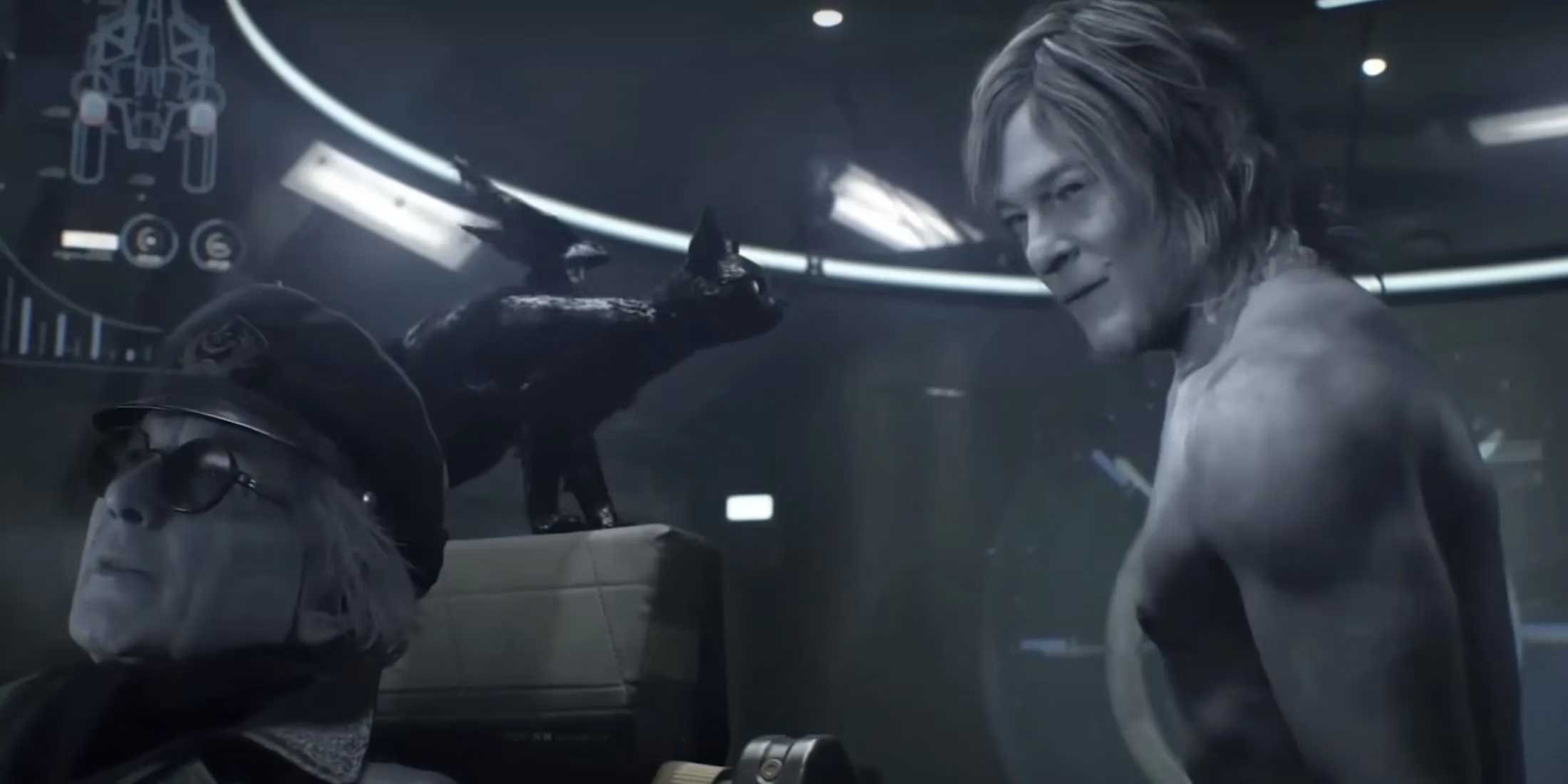
Unlike the first game's marketing cycle, Death Stranding 2 operates with established lore that changes how information is processed. We're not learning about Beaches and BTs for the first time; we're seeing how these concepts evolve and intersect with new elements. This creates a fascinating dynamic where each reveal must serve both newcomers and veterans—explaining enough to be accessible while suggesting deeper connections for those already immersed in Kojima's unique mythology.
The emotional throughlines from the first game create what I'd describe as narrative gravity—certain concepts (like connection, loss, and rebirth) exert pull on new information, bending it toward established themes while allowing for surprising deviations. Lou's memory hangs over everything like a spectral presence, influencing how we interpret every new character and situation.
The Waiting Game: Psychology of Anticipation
Kojima understands something fundamental about modern gaming culture: anticipation has become its own form of engagement. Between now and Death Stranding 2's 2025 release, the community will:
-
📊 Create elaborate connection charts between revealed elements
-
🎭 Analyze every frame of released footage for hidden meanings
-
💭 Develop increasingly complex theories about narrative directions
-
🔄 Revisit the first game with new contextual understanding
This period of speculation isn't incidental—it's engineered. By giving us just enough to speculate about but not enough to solve, Kojima turns the waiting period into an extension of the gameplay experience itself. We're already playing Death Stranding 2 through theorycrafting and analysis, making the eventual physical playing feel like the culmination rather than the beginning of our engagement.
Cultural Context and Global Release Strategy
The Tokyo Game Show focus on Japanese audiences reveals an interesting strategic layer. By catering first to his domestic market, Kojima acknowledges cultural specificity while building toward global understanding. The voice actor reveals matter differently in Japan, where voice talent carries celebrity status comparable to Hollywood actors in the West. This layered approach to information release—different details emphasized for different audiences—creates a richer, more nuanced pre-release conversation than a single global trailer ever could.
Looking Toward 2025: The Final Approach
As we move closer to release, I expect Kojima's information strategy to shift from obfuscation to controlled revelation. The photo mode and performance reveals represent the "safe" territory—features that can be shown without spoiling narrative surprises. What comes next will likely follow a similar pattern: system mechanics, graphical showcases, maybe another celebrity cameo announcement. The core narrative will remain protected until players hold controllers in their hands, experiencing the connections between tar proteins, unborn children, and expanded networks through gameplay rather than previews.
This approach represents a bold faith in both the material and the audience. Kojima believes his story is strong enough to withstand months of speculation without being "figured out," and that players are sophisticated enough to enjoy the mystery as much as the eventual revelation. In an industry often criticized for showing too much too soon, Death Stranding 2's marketing feels refreshingly patient, treating information like a precious resource rather than a disposable commodity.
Conclusion: The Strand That Connects Us All
What makes Death Stranding 2's approach particularly compelling in 2025's gaming landscape is how it mirrors the game's own themes. Just as Sam Bridges connects isolated cities through physical and metaphysical networks, Kojima connects players through shared speculation and anticipation. The information he releases acts like chiral crystals—fragments of something larger that resonate across distances, creating connections between people who might otherwise remain isolated in their individual expectations.
The wait for Death Stranding 2: On the Beach has become, in many ways, the first strand in a new network of player connection. And when we finally play the game next year, we'll discover that the journey didn't begin with the start screen—it began the moment Kojima showed us that first mysterious photo mode demonstration and trusted us to wonder about everything he wasn't showing.
That sense of anticipation naturally extends beyond the narrative itself. When a game of this scale finally arrives, the practical rituals of preparation become part of the experience—ensuring your platform is ready, your controllers are charged, and your account is stocked with whatever digital currency you might need for the inevitable post-release cosmetics or expansions. In the same way Kojima carefully parcels out information as a gift to his audience, players have their own ways of gifting themselves a frictionless launch-day experience, setting everything in place so that the first strand can be woven without interruption.
For many, that means taking advantage of convenient services that streamline the business side of gaming. Platforms like Lootbar offer players an efficient way to handle game top-ups and digital purchases, allowing you to focus entirely on the experience rather than the logistics. By the time Death Stranding 2: On the Beach finally lands, the only thing that should matter is the connection you build with the world Kojima has crafted—not the friction of payment screens or wait times. After months of speculation and shared wonder, getting straight into the game is the truest reward for being part of that journey.