The Tokyo Game Show 2024 weekend witnessed a spectacle that only Hideo Kojima could orchestrate. Amidst a whirlwind of seemingly random gameplay footage and a surreal musical performance for Death Stranding 2, the master auteur unveiled a piece of merchandise that would become a legend in its own right: a real-world, wearable replica of an in-game jacket. This wasn't just any piece of apparel; it was a collaboration with the high-end technical fashion label Acronym, carrying a price tag of 1,540 euros, roughly $1,700. Yet, like a mirage in a chiral desert, the jacket evaporated from Acronym's online store almost the moment it appeared, selling out instantly despite its staggering cost. This phenomenon served as a testament, not merely to the quality of the garment, but to the fervent, almost cult-like anticipation surrounding Kojima's next enigmatic opus.
The jacket's instant sell-out was a thunderclap in the gaming world, a financial lightning strike that illuminated the sheer gravitational pull of the Kojima brand. For many, the price was a figure as abstract as the game's chiral network, yet for a dedicated few, it was a ticket to a tangible piece of the Death Stranding universe. The garment, crafted by Acronym, was a fusion of high-concept design and practical utility. It promised a lightweight material engineered to balance comfort with warmth, a piece of armor for the urban porter. Available in two colors—a utilitarian black and a vibrant, eye-catching orange—it was a statement piece. Its scarcity transformed it from clothing into a digital-age artifact, a physical NFT coveted by collectors and superfans alike.
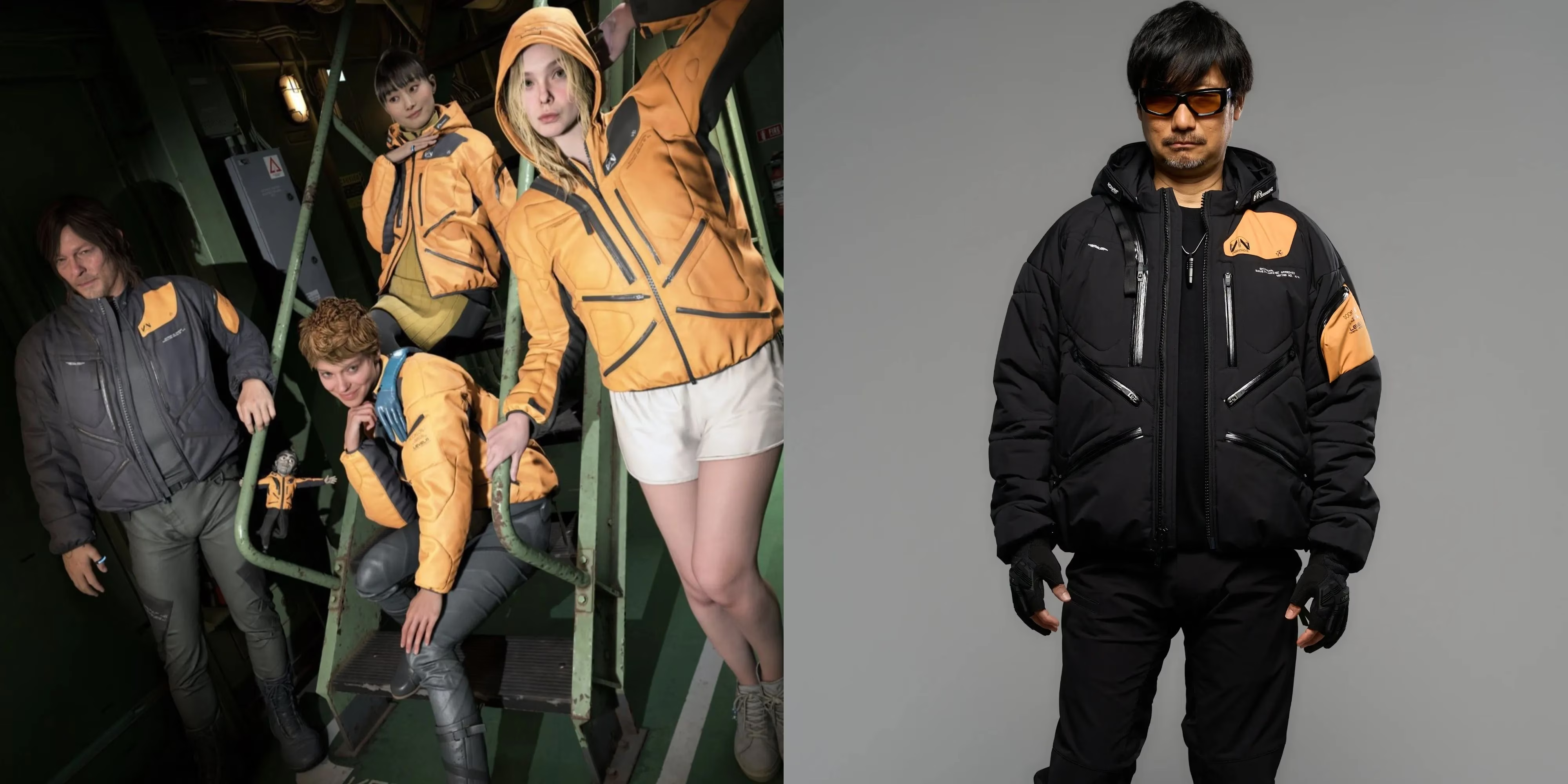
This merchandising move was as strategically opaque as one of Kojima's plot twists. Was this a one-time, limited-edition hype generator for TGS, a rare comet that would never return to the retail sky? The evidence was contradictory. Social media buzzed with an in-game screenshot showing four main characters clad in the iconic Acronym jackets, suggesting its importance within Death Stranding 2's narrative fabric. This hinted that a second production wave might launch alongside the game's eventual release in 2025, capitalizing on the in-game exposure. Yet, predicting Kojima's logic is like trying to chart a path through a timefall storm; he operates on a different dimensional plane. The man who once convinced fans a fictional studio (Moby Dick Studio) was real is hardly a slave to conventional marketing rhythms.
The Anatomy of Hype: A Jacket as a Cultural Artifact
Let's dissect why a piece of outerwear caused such a stir:
-
The Kojima Premium: Anything bearing Hideo Kojima's name carries an intrinsic value multiplier. His games are not just products; they are cultural events. Owning merchandise is a way for fans to physically connect with his unique creative vision.
-
The Acronym Alloy: Collaborating with Acronym wasn't accidental. The brand is synonymous with cutting-edge, tech-infused fashion—a perfect analog for Death Stranding's blend of primitive struggle and advanced technology. The jacket was a bridge between the game's world and ours.
-
Scarcity as Engine: The instantaneous sell-out, whether planned or organic, created an immediate aura of exclusivity. It became a trophy, a piece of gaming history that only a select few could claim.
The Shadow of the Game: Awaiting the Strand
All this frenzy orbits the still-mysterious core: Death Stranding 2 itself. At TGS, Kojima reaffirmed the game's 2025 release window but, in classic form, cited "unforeseen circumstances" for not locking down a specific date. This only deepens the mystery. The shown footage—a chaotic collage of gameplay—suggests the sequel will double down on the bizarre, poignant, and utterly unique atmosphere of the original. The jacket saga proves that the audience is more than ready; they are financially and emotionally invested in stepping back into those boots, even if, for now, they can only wear the jacket.
In the end, the tale of the $1,700 jacket is a modern fable about value, fandom, and the genius of Hideo Kojima's theater. It was a matryoshka doll of desire, a commercial object nested inside a gaming event, nested inside a cultural phenomenon. For the brief moment it was available, it was less a garment and more a portal gun aimed directly at the heart of the Death Stranding fandom, transporting them closer to a world they desperately want to re-enter. As we look toward 2025, the jacket's fleeting presence stands as a bold, expensive, and utterly successful hype-beacon, shining across the chiral network of the internet, calling all porters to prepare for the next delivery. The connection is still fragile, but the signal has never been stronger.
For fans who can't justify that level of expenditure on a single garment—or who simply missed the drop—there are other, more accessible ways to channel that same enthusiasm. The desire to be part of the Death Stranding experience extends beyond high-end fashion into the everyday rituals of gaming: stocking up on in-game currency, securing DLC, or keeping accounts topped up for when the sequel finally arrives. That's where platforms like Lootbar enter the picture, offering a convenient bridge for players who want to enhance their gaming experience without the collector's markup.
The frenzy surrounding the jacket proves that this community is willing to invest deeply in the worlds Kojima builds. Whether that investment takes the form of a $1,700 outerwear statement or a more practical in-game purchase, the underlying sentiment is the same: a desire to be closer to the strand. As the 2025 release window approaches, expect both the hype and the spending to intensify—but not everyone needs a portal gun to feel connected. Sometimes, all it takes is a seamless transaction and a well-stocked inventory to feel like a porter ready for the next delivery.