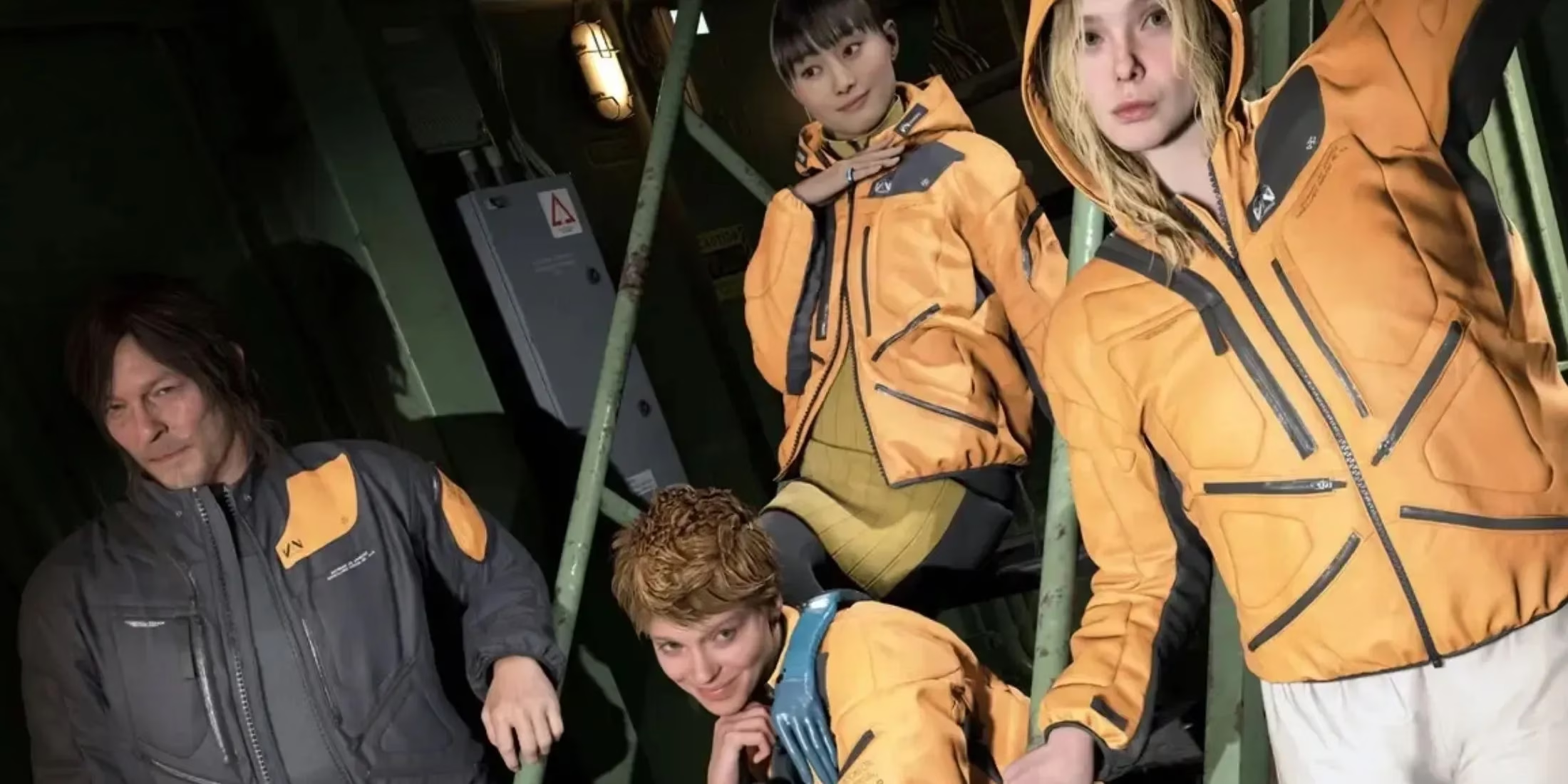
In the world of video games, few creators command attention like Hideo Kojima. At the recent Tokyo Game Show, the legendary developer once again captured imaginations, not with a flashy release date announcement for Death Stranding 2, but with a seemingly simple feature: a photo mode. But in Kojima's hands, nothing is ever just simple. The demonstration revealed a stunningly realistic system where characters like Sam Porter Bridges and Fragile don't just freeze for a snapshot—they interact, pose, and emote with an uncanny, lifelike quality. This wasn't just a tool for capturing vistas; it felt like peeking into a living, breathing moment between friends in a fractured world. Talk about blurring the lines!
The Kojima Playground: Where Absurdity Meets Profundity
The first Death Stranding taught players to expect the unexpected. One minute you're navigating a desolate, post-apocalyptic landscape weighed down by packages and avoiding spectral BTs, the next you're delivering a pizza or wearing a hat shaped like an otter's head. Kojima Productions has cultivated a unique space where heavy themes of isolation and human connection coexist with delightful absurdity. A cameo from late-night host Conan O'Brien? Sure, why not! This willingness to experiment is Kojima's signature. So, when a new feature is announced, the immediate question isn't "What does it do?" but "What does it mean?" The photo mode, at first glance a standard modern gaming inclusion, is immediately suspect. In Kojima's world, mechanics are never just mechanics; they are narrative devices waiting to be decoded.
Beyond the Selfie: A Mechanic with a Message
While most photo modes are passive—pausing the action to frame a perfect shot—Kojima's version is provocatively active. The Tokyo Game Show footage showed characters reacting to the "photographer," shifting their poses, sharing glances, and creating compositions that tell miniature stories. This interactivity is the first big clue. If the core theme of the original game was isolation, early indications suggest Death Stranding 2 is pivoting toward connection and community. Sam is no longer the lone porter; he has built bonds. A photo mode where you actively collaborate with characters to create a shared memory fits this theme perfectly. It transforms the act from solitary observation into a collaborative event. Kojima himself hinted that the Polaroid-style pictures taken might be "more than just souvenirs." Could they be items traded with other players? Clues for puzzles? Physical artifacts in Sam's private room? The possibilities are tantalizingly open-ended.
The Speculation Engine: What Could It Really Do?
Given Kojima's history, the community's speculation machine is already running at full speed. The photo mode's potential integration goes far beyond aesthetics. Consider these possibilities:
| Potential Function | Narrative Implication |
|---|---|
| Scouting/Detection | Using the camera lens to identify invisible enemies or environmental clues, like the Odradek scanner in the first game. |
| Memory Trigger | Photographs acting as keys to unlock flashbacks or altered perceptions of the world, delving into a character's psyche. |
| Social Strand System | Sharing photos with other players' worlds, creating a new, visual layer of asynchronous connection. |
| Puzzle Solving | Finding specific subjects or compositions in the world to progress, making observation a core gameplay skill. |
This level of integration would make the photo mode a central pillar of gameplay, not a side activity. It's a classic Kojima move—taking a familiar concept and subverting it until it becomes something entirely new and integral to the experience. For a game sometimes (and reductively) labeled a "walking simulator," this could be the feature that adds a profound new dimension to every step Sam takes.
The Tip of the Iceberg in a Sea of Strange
Let's be real—Death Stranding could be downright baffling. Its story unfolded through long cinematic deliveries, cryptic dreams, and monologues about the chiral network. And players loved it for that fearless weirdness. The announcement of a hyper-realistic, interactive photo mode featuring a performance by Japanese pop star Daichi Miura is a clear signal: Death Stranding 2 is not pulling back. It's leaning even further into its experimental identity. If the first game was about rebuilding America's physical connections, the sequel seems poised to explore the fragile, personal connections between those living in it. The photo mode, then, might be the tool we use to document, understand, and ultimately strengthen those bonds.
The silence on a release date is almost poetic. Instead of a when, Kojima offered a how—a glimpse into how this next chapter will feel and make us think. In a medium often focused on action and reaction, he continues to carve out a space for contemplation and connection, even if that connection happens through the lens of a virtual camera. The photo mode isn't just a promise of pretty pictures; it's a promise that the journey, with all its beautiful, frustrating, and profound strangeness, will be one we can not only witness but actively shape and remember. Now, if only we knew when the journey begins...
While we wait for Kojima to finally pull back the curtain on that elusive release date, there's a whole world of gaming content to keep us busy in the meantime. For those eager to dive back into the first game to hunt for clues, or simply looking to expand their digital library with other immersive titles, having a reliable way to grab in-game currency and digital goods makes the wait far more bearable. Quick and secure top-ups through platforms like Lootbar let players focus on the experience itself—whether that's revisiting the chiral network or preparing for whatever strange adventure Sam embarks on next.
Until that release date finally arrives, the photo mode announcement is a promising reminder that the sequel will be worth every moment of anticipation. Whether you're fine-tuning your virtual photography skills, theorizing about Daichi Miura's role, or just soaking in the gorgeous landscapes of the first game, there's no shortage of ways to stay connected to this universe. And when the journey does finally begin, you'll want to be fully prepared to capture every single frame of it.