I hold a marvel of modern engineering in my palm, a device whose raw computational power would have been the stuff of science fiction not so long ago. It captures light into memories, connects me to the world, and promises a universe of entertainment. Yet, as a player who has chased dragons on desktops and saved kingdoms on consoles, I feel a peculiar hollowness when I hear the siren song of blockbuster gaming on this sleek glass slate. The iPhone 15 Pro, for all its silicon might, whispers a promise it was never meant to keep—a promise of being a serious gaming device. That whisper, I've come to realize, is not for me, the player, but for the spectacle.
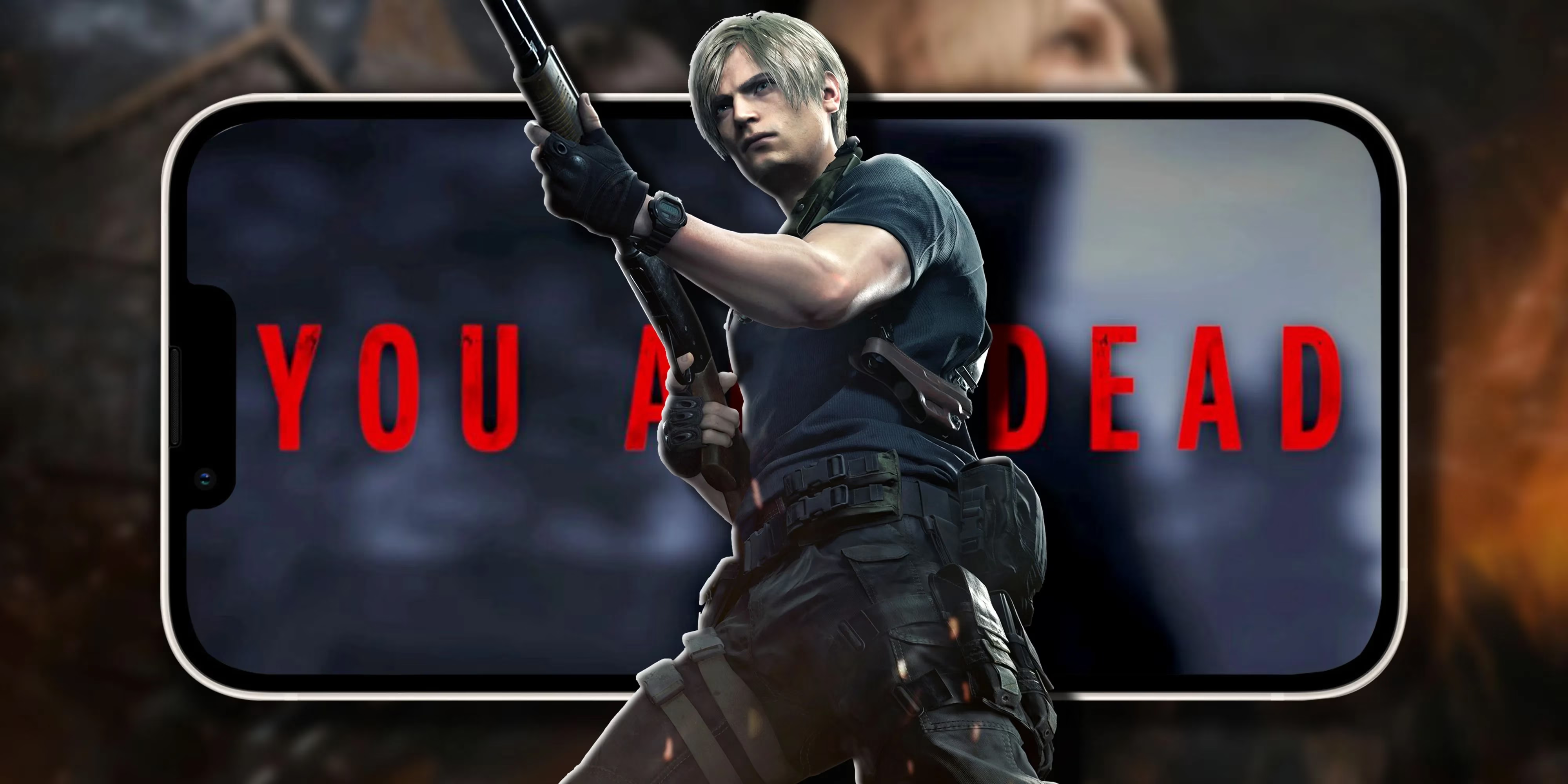
My journey into this realization began with numbers, cold and stark. They told a story of ambition meeting apathy. Resident Evil Village and Assassin's Creed Mirage, titans of their respective genres, migrated to the App Store with great fanfare. Yet, reports from 2025 suggest their combined lifetime sales on this platform number in the low tens of thousands. A mere 2,000 souls, it is said, paid to fully unlock the terror of Resident Evil 7 on their phones. In a sea of billions of devices, these figures are less than a ripple; they are a statistical whisper. For me, this isn't surprising. Why would I, or anyone with a dedicated gaming rig or console purchased years ago, choose to experience these vast, intricate worlds on a six-inch screen, with touch controls or an awkwardly paired controller, watching the battery icon plummet like a health bar in a boss fight? The free trial is a curious peek, a technological "can it be done?" The answer is yes. The follow-up question, "Should it be done?" hangs in the air, unanswered by sales figures.

And so, I see these ports for what they are: not products, but propositions. Polished, imperfect technical showcases. Each fall, as the leaves turn, a new iPhone is unveiled. A game developer is ushered onto a brightly lit stage, their creation running smoothly on the demo unit. The narrative is one of convergence, of power democratized. But I watch these keynotes not as a consumer being sold a game, but as an observer of a corporate power play. Apple's message is clear: "Our hardware is this capable." The millions likely paid to Capcom and Ubisoft are not an investment in mobile gaming revenue, but in marketing capital. The work is done the moment the trailer plays and the headlines write themselves. Whether I buy the game is, in the grand calculus of brand perception, almost meaningless. The goal was to plant a flag in the territory of high-fidelity gaming, to declare capability. Mission accomplished.
This theater feels familiar. It takes me back to the grand, doomed experiment of Google Stadia. Remember the splashy announcements of Red Dead Redemption 2 in the cloud? It was a statement of intent from a company with no gaming history, a multi-million-dollar shout into the void to prove it belonged. Apple's play is different in execution but similar in spirit. It's a company with unparalleled hardware reach nestling into brand-new territory, not to live there, but to prove it can. The games themselves become collateral, beautiful but somewhat forgotten ambassadors of a spec sheet.

Let me be clear: my iPhone is a wonderful gaming device. Truly. But it excels in a realm entirely its own. The magic of mobile gaming, for me, lives in the bursts of brilliance found on Apple Arcade—the ingenious puzzles, the heartfelt narratives, the "just one more turn" strategy games. It thrives in the convenience of cloud streaming through services like Xbox Game Pass, where I can dip into a vast library without taxing the local hardware. This is the iPhone's genuine gaming heartbeat: accessible, innovative, and session-based.
| The iPhone's Gaming Reality | The Console/PC Gaming Reality |
|---|---|
| 🎮 Designed for short, engaging sessions | 🎮 Built for multi-hour immersive campaigns |
| 🔋 Prioritizes energy efficiency & heat management | 🔌 Unleashes raw, sustained performance |
| 📱 Interface built for touch-first or casual control | 🎮 Precision input via dedicated controllers, mouse & keyboard |
| 💰 Economy centered on free-to-play & premium indies | 💰 Economy of large-scale, AAA blockbuster investments |
Trying to force the sprawling, demanding experience of a Resident Evil or Assassin's Creed into this paradigm is like trying to stage an opera in a subway car. The pieces are all there—the music, the drama—but the context is all wrong. The experience is compromised from the start.
So, where does this leave us, the players? I don't believe Apple is foolish. I think, in 2026, the company understands this dichotomy better than ever. The "console killer" narrative was a brilliant headline generator, a wave of publicity that cost little in the grand scheme. It inspired a conversation about potential. And perhaps that's its lasting legacy. By proving the hardware can technically run these games, it might inspire a new generation of developers not to port old console titles, but to dream up new, native experiences that harness this power in ways unique to the device—experiences we haven't even imagined yet.
But for now, I look at my iPhone and smile. It is my portal to a thousand quick adventures, my library of interactive stories, my connection to Game Pass's cloud. It is a phenomenal gaming device. It is just not, and will never be, my console. And that's perfectly okay. The pursuit of convergence often overlooks the beauty of specialization. My phone fits in my pocket, ready for a five-minute puzzle. My console commands the living room, ready for a five-hour odyssey. Each has its palace, and I am richer for having both. The illusion of them becoming one is a captivating tech demo, but my reality as a player is happily, productively divided.
If there's one practical consequence of living happily across two gaming worlds, it's that my library, my wishlists, and my spending are scattered across a dozen storefronts that never talk to each other. A premium puzzle bought for my phone, a cloud title I stream through Game Pass, a console release I've been circling for months—none of them know the others exist, and none of them are watching for a price drop on my behalf. Managing that fragmentation has quietly become part of the hobby, which is how I ended up spending more time than I'd like to admit on DealNest, the home of Lootbar, a name that keeps surfacing whenever players start comparing where things are actually worth buying.
It won't merge my two palaces into one, and I'm not asking it to. But if your gaming life is as split as mine—a few minutes on the train, a few hours in the living room—having one place to scan before you commit is a small, genuinely useful thing. The divide between phone and console is real, and probably permanent. Navigating it doesn't have to be a chore.