The liminal spaces between life and death, memory and reality, continue to unravel in the haunting world crafted by Hideo Kojima. As the sands of time fall toward 2026, the anticipation for Death Stranding 2: On the Beach builds not merely upon the foundations of its predecessor but upon the fractured identity of its central figure, Sam Porter Bridges. The very essence of who Sam is—or perhaps, who he was—has become the game's most profound mystery, a puzzle box nestled within the metaphysical shores of the Beach. The footage revealed so far paints a portrait of a man transformed, weathered by unseen storms, suggesting the porter we knew may have been irrevocably altered by his unique connection to the realm between.
At the heart of this enigma lies the Beach itself, that purgatorial expanse Kojima established as the core of Death Stranding's lore. It is more than a setting; it is a character, a state of being, a reflective surface for the soul. This metaphysical realm, existing between life and death, is deeply personal—a mirror to one's innermost thoughts, emotions, and experiences. For ordinary souls, it is a transient waystation. For Repatriates like Sam, it is a recurring nightmare and a revolving door, a place from which they can return, but never unchanged. Each death and subsequent repatriation is not a perfect restoration; it is a reconstruction. Could it be that the Sam who emerges in the sequel is a copy of a copy, his soul and body having undergone a separation so profound that the man who walks the ruined Earth is but an echo, missing crucial memories or bearing a personality subtly rewired by the Beach's enigmatic currents?
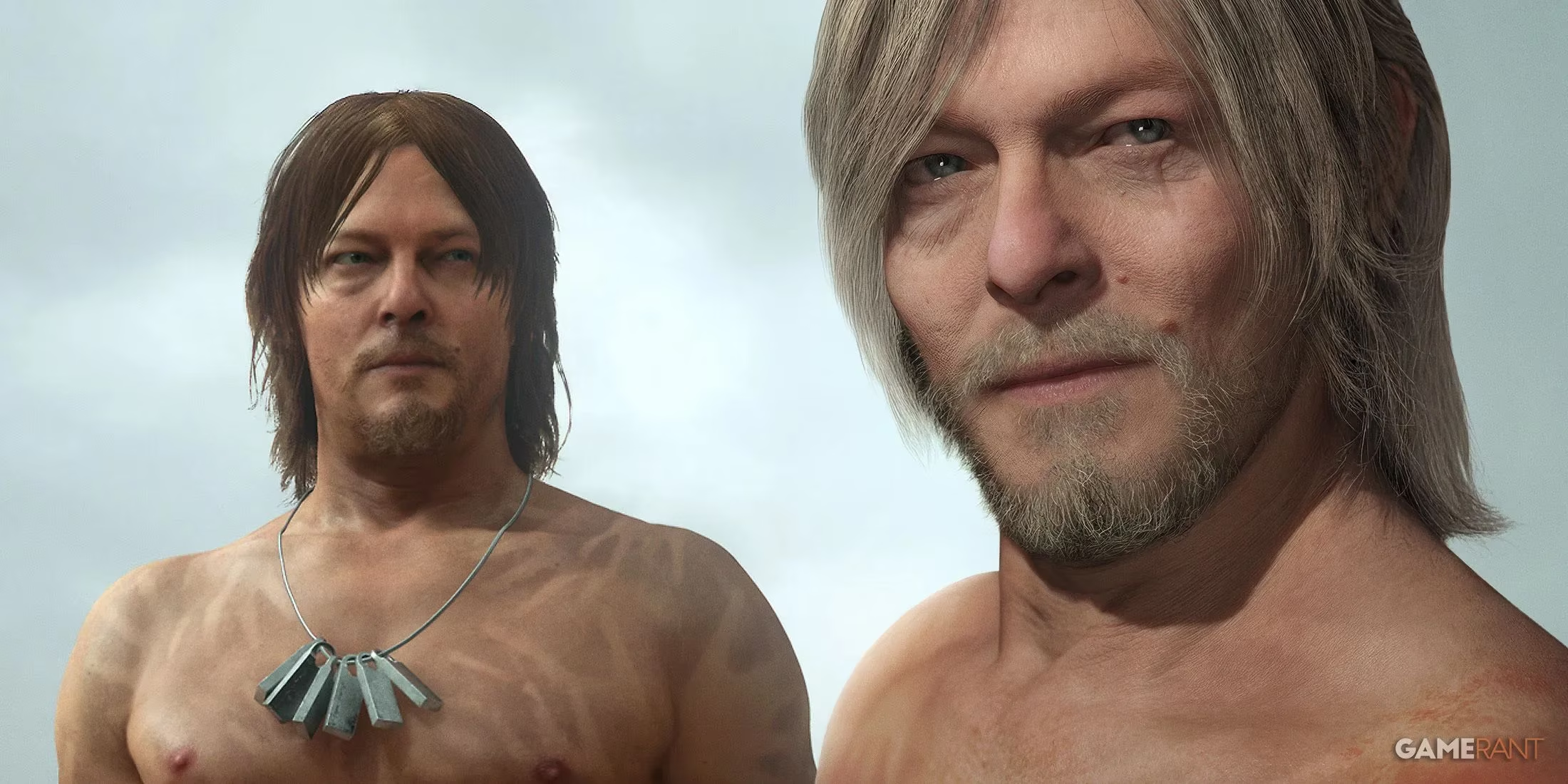
The visual evidence is stark and contradictory, fueling the theory of multiple Sams. The weary, white-haired figure from the initial teaser trailer carries the weight of decades in his eyes, a stark contrast to the determined porter of old. His confusion, his palpable disorientation, speaks not of a man on a mission but of a soul adrift, perhaps newly assembled on the shore. Yet, in later footage, a younger Sam with familiar brown hair reappears, seemingly active and engaged. This dichotomy rejects a simple linear timeline. Is it merely the effect of Timefall, accelerating age in a world where rain steals years? For a creator like Kojima, such a straightforward answer feels like a feint, a piece of misdirection hiding a grander design involving duality and parallel existence.
Consider Sam's arc at the conclusion of the first game. He achieved a hard-won peace, severing his ties with the United Cities of America to embrace a life of quiet isolation with the infant Lou. For this Sam to willingly re-enter the fray would require a cataclysm of personal magnitude. But what if the call to action is not for our Sam? What if the man answering the call is a different iteration entirely—one whose history, whose connection to Lou and the UCA, is fundamentally altered? The subtitle On the Beach is not merely a location; it is a state of existence. It suggests the entire narrative may unfold within or be dictated by the rules of that metaphysical shore, where identities are fluid and the self is not a singular point but a spectrum of possibilities.
-
The Repatriate's Paradox: Sam's ability to return from death is a unique curse. Each return is a journey through the Beach, a realm that reflects and potentially reshapes the soul. The integrity of the self cannot be guaranteed after multiple passages.
-
A Tale of Two Porters: The visual dichotomy between the old, white-haired Sam and the younger, familiar one may represent:
-
Two distinct points on a single, non-linear timeline.
-
Two parallel versions of Sam existing concurrently, perhaps from different "strands" of reality.
-
One physical Sam and one manifested from the Beach, a "Beach-bound" echo.
-
-
Narrative Mechanics: Kojima has historically played with identity (Solid Snake, Liquid Snake, Venom Snake) and perception (Metal Gear Solid 2's protagonist switch). Death Stranding 2 could use multiple Sams as a core gameplay and thematic mechanism, exploring connection from the perspective of disparate versions of the same man.
The most compelling theory weaves these threads into a tapestry of tragic inevitability. The older, wearier Sam from the teaser could indeed be the original porter from the first game, summoned from his isolation years later by a crisis involving his younger counterpart. This younger Sam, active in the 2024 State of Play footage, might be a newer reconstruction, one who operates with a different set of memories and drives. Their paths could cross in a story that examines what makes a person themself: Is it memory? Is it purpose? Or is it the connections they forge, even across different iterations of their own being?
As the release draws nearer, the community speculates with a mix of dread and excitement. Kojima's genius lies in making the question of identity the game's central journey. We are not just waiting to see what Sam will do next; we are waiting to discover which Sam will do it. The Beach awaits, and on its shores, the lines between one man and his many reflections are destined to blur, promising an experience as philosophically rich and emotionally charged as the eerie, beautiful world it inhabits. The final truth of Sam Porter Bridges remains, like the chiralium-laden landscapes he traverses, hauntingly out of reach, visible only in fragments and echoes across the sand.