As the mobile gaming landscape continues to evolve at a breakneck pace, the eternal battle between lightweight contenders and graphical powerhouses rages on. In the year 2026, the debate between PUBG Mobile Lite and Call of Duty: Mobile for gamers with modest hardware remains as lively as ever. Both titles have carved out their own legions of loyal fans, primarily thanks to the heart-pounding, immersive battle royale thrills they deliver right to our pockets. However, when the rubber meets the road—or rather, when the game loads on an older or budget-friendly smartphone—the differences in their philosophies become glaringly apparent. One was born from the desire to bring high-octane action to everyone, while the other pushes the visual envelope, sometimes at the cost of accessibility. Let's dive into the nitty-gritty of specs, performance, and pixels to see which game truly reigns supreme for the frugal gamer.
🎮 Minimum System Requirements: The Entry Ticket
Before any bullets fly or chicken dinners are served, your phone needs to pass the initial test. Here’s where the two titles lay down their cards:
| Feature | Call of Duty: Mobile | PUBG Mobile Lite |
|---|---|---|
| Download Size | ~2.5 GB (as of 2026 updates) | ~600 MB (still impressively lean) |
| Minimum OS | Android 7.0 / iOS 11 | Android 4.1 (a true relic-runner!) |
| Minimum RAM | 2 GB (3 GB recommended) | 1 GB (2 GB recommended) |
| Processor | 64-bit, mid-range chipset | Qualcomm or equivalent (very forgiving) |
A quick glance tells the whole story. COD Mobile has become a bit of a diva over the years, demanding more resources with each seasonal update packed with new maps, operators, and cosmetic bling. Its official stance remains that 2 GB of RAM is the bare minimum, but veterans know that for a smooth experience, you'd better have a bit more juice under the hood.
PUBG Mobile Lite, on the other hand, is the steadfast friend who hasn't changed their number. Designed from the ground up for low-end devices, its requirements are almost charmingly modest. With a footprint that's a fraction of its competitor's, it's the game you can still install when your phone's storage is crying for mercy after a holiday photo spree. The key takeaway? If your device is from the pre-2020 era or is a modern budget model, PUBG Mobile Lite rolls out the welcome mat. COD Mobile might just check your ID at the door.
🖼️ Graphics & Visual Fidelity: A Tale of Two Philosophies
Now, let's talk about the eye candy—or in some cases, the sensible, performance-friendly visuals.
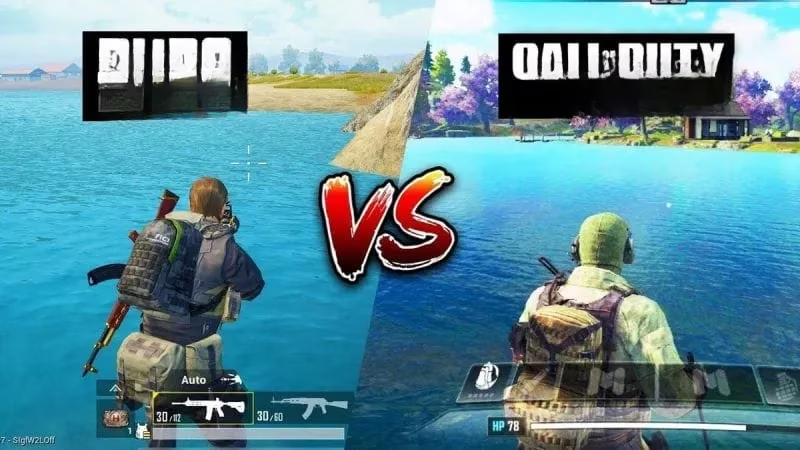
PUBG Mobile Lite continues to work its magic with the Unreal Engine 4, a powerhouse typically reserved for desktop gaming behemoths. The developers have performed wizardry in scaling it down. The result?
-
Realistic, life-like textures on maps like Varenga and Golden Woods.
-
Detailed environmental frames with high-contrast color schemes that help in spotting enemies.
-
A remarkable degree of graphic customization. Players can tinker with frame rates and visual settings to find the perfect balance between beauty and performance on their specific device.
The game doesn't try to win a neon-lit art contest; it aims for a gritty, believable aesthetic that runs smoothly. It’s the reliable pickup truck of mobile graphics—not flashy, but it gets the job done without breaking down.

Call of Duty: Mobile takes a different route. It’s the arcade on your phone:
-
Vibrant, almost electric color palettes that make every match feel like an action movie.
-
Highly detailed character models and weapon skins (some with enough glitter to signal distant planes).
-
Dynamic lighting and flashy effects for every killstreak and ultimate ability.
However, this visual spectacle comes with a caveat. The style is less about military simulation and more about fast-paced, arcade-themed chaos. While it's visually captivating and designed to 'wow' players, this richness is precisely what can cause older hardware to sweat. Textures that fascinate on a flagship phone can become a slideshow on a budget device.
⚡ Performance & Gameplay Smoothness: The Frame Rate War
Here’s the real battleground for low-end devices: consistent performance. All the visual splendor means nothing if the game stutters just as you're lining up the perfect headshot.
-
High Frame Rate Support: Both games offer 60 FPS modes, but this is largely the domain of mid-range and flagship phones in 2026.
-
The Low-End Reality:
-
PUBG Mobile Lite: This is its home turf. Optimized explicitly for 1-2 GB RAM devices, it delivers a noticeably smoother and more consistent frame rate. Gameplay is generally lag-free, and sessions don’t typically degrade into a jittery mess over time. It’s the king of stability.
-
Call of Duty: Mobile: This is where struggles emerge. On devices meeting only the minimum specs, players often report:
-
Periodic lag spikes during intense firefights or when multiple abilities are used.
-
Jittery frames and stuttering, especially in the later stages of a match or during extended play sessions as the device heats up.
-
Longer loading times for maps and character models.
-
-
Think of it this way: PUBG Mobile Lite is a tailored suit, made to fit the constraints of low-end devices perfectly. COD Mobile is an off-the-rack, extravagant costume—it might look incredible if you're the right size (have a powerful phone), but it can be cumbersome and restrictive if you're not.
🏆 Verdict & The Gamer's Choice in 2026
So, which title boasts better graphics for low-end devices? If we define "better" as a combination of visual clarity, stability, and consistent performance, the crown still goes to PUBG Mobile Lite. Its graphics are not the most flamboyant, but they are highly optimized, realistic, and, most importantly, reliable. It proves that a great visual experience doesn't have to mean bringing your phone's processor to its knees.
Call of Duty: Mobile is undeniably the more visually ambitious and content-rich game overall, with a constant stream of updates keeping it fresh. However, that ambition comes at a significant performance cost on entry-level hardware. Its graphics are "better" in a vacuum of pure detail and style, but not in the practical context of a low-end device struggling to run it.
Ultimately, the choice is a personal one, dictated by your priorities:
-
Choose PUBG Mobile Lite if you value: Stable performance, lower storage use, and playable graphics on virtually any device. It's the democratizer of battle royale fun.
-
Choose Call of Duty: Mobile if you have: A relatively capable low-mid-range device and prioritize flashy visuals, faster-paced arcade action, and a huge variety of game modes, and don't mind occasional hiccups.
In the end, both games deserve applause for bringing console-like experiences to mobile. But for the vast army of gamers riding with trusty, older smartphones in 2026, PUBG Mobile Lite remains the undisputed champion of accessible, smooth, and visually competent warfare. It’s the proof that in the world of gaming, sometimes, less truly is more. 🥇